
A short story · The Negev, circa AD 240 · 7 minute read
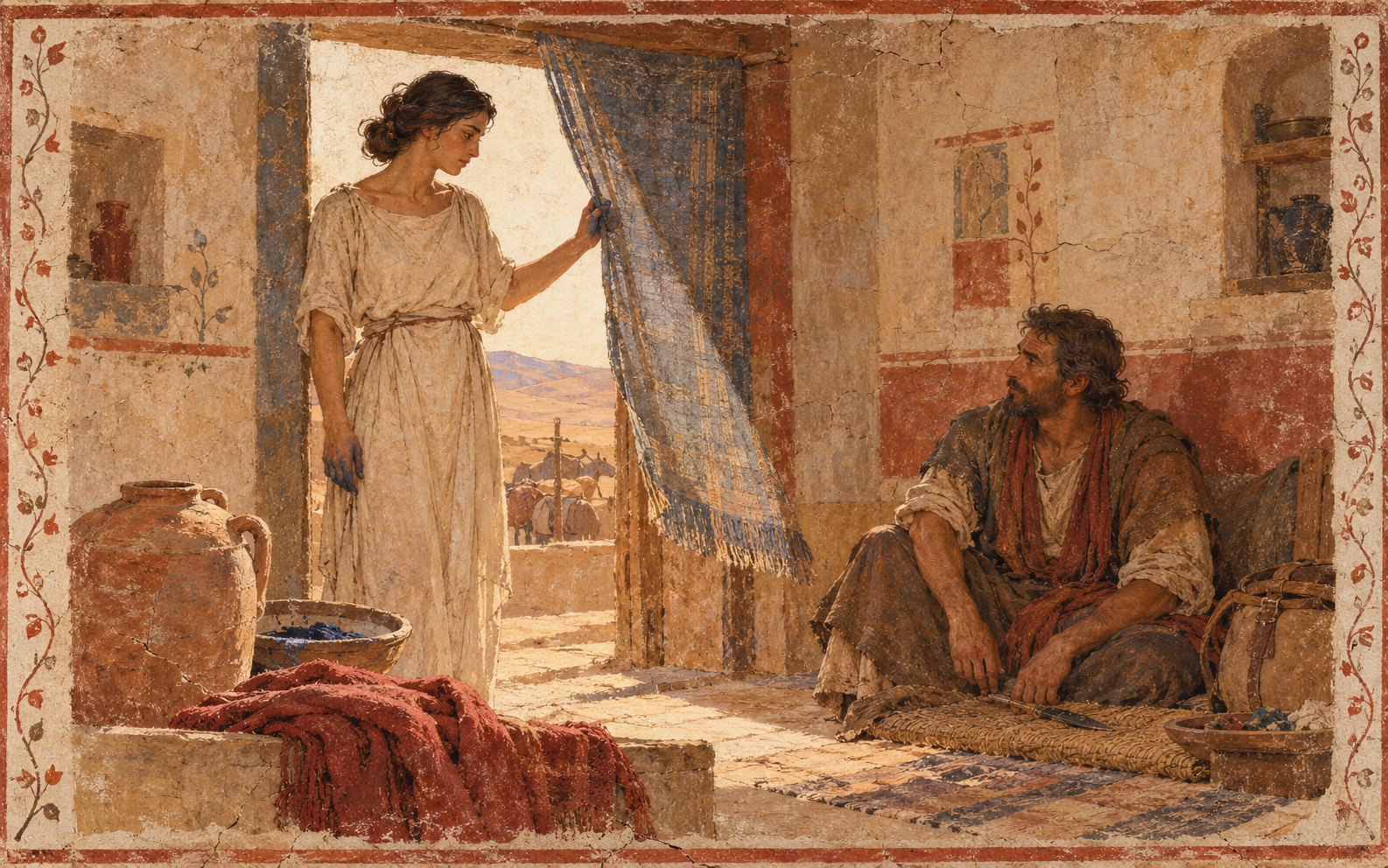
By the third day of the wind the water in the jar had a skin on it, and Shelam skimmed it with the side of her hand before she poured. The cloth over the doorway had dried again. She wet it from the cup and hung it back, and the light through it went the colour of an old coin.
Taimu sat with his back to the cool wall and turned the small knife over and over. He had been turning it for an hour.
He had come home from Petra eleven days ago with something behind his eyes. She knew his face as she knew the yard — where the step was worn, where the wall wept in winter — and there was a new thing in it. Twice at the evening meal he had started to speak, and looked at the boy, and stopped. Once she had come up the stair to the roof and found him with the camel master, and they had gone quiet as the doves go quiet.
She had made her list the way she made the list for the market.
“Hegra has a good market for wine, they say,” she said. “The houses there are fine.”
“Fine enough.” He did not look up.
“A man could keep a house there. Many do.”
“Many do.” The knife turned. “I don’t like the water.”
So it was not a woman in Hegra. She crossed it off, and found the list no shorter.
The wind leaned on the door. Sand hissed along the sill. From the women’s side she heard her mother in law hushing Yonatan, whose nose had bled at noon, as it always did in this wind, and who was frightened of the blood though he pretended not to be.
“Your brother came to the gate before the wind,” she said. “He had the look of a man counting.”
“He’s always counting.”
“Was it the vineyard he was counting?”
Taimu’s hands stopped. “Why would he count the vineyard?”
“I don’t know. Why would he?”
He set the knife down on the mat between them, carefully, as if it might roll. Her heart went with it. So it was the land.
She looked at her hands in her lap. The blue had not come out from under the nails. It never did.
She had come through that gate eight years ago with a child at the breast and nothing else — no dowry, no blessing, no brother to speak for her — put out by her first husband before the birth blood had stopped, and taken in by this clan because the old man had owed her father something and was too proud to die owing it. The elder brother’s wife had come with camels and a written contract. Shelam had come with the boy and the smell of the road. She had been grateful, and had swallowed the gall of it, and had kept to the back of the yard.
That was where he had found her: not in the women’s rooms, where he never lingered, but at the far wall by the midden, over a cracked pot of madder root she had dug from the wadi and a rag of his mother’s old wool gone the colour of a pomegranate’s inside. She had thought he would take the pot from her. Instead he had looked at the rag for a long time, the way he looked at cloth in the market, and then asked her what she had used to make the red hold. She told him, because no one had asked her anything in a year. Her mother’s people dyed goat hair for tent bands, and there was a spring in their country whose mud fixed red as nothing else did, and she had carried a little of that mud in a twist of leather from the day she left.
He said nothing more that day. He did not say much on any day. But when he next came back from the south there was a cake of indigo in his saddlebag that no one had asked him for, and a sack of roots, and the time after that a proper vat. When his brother complained of the stink of stale piss from the back of the yard, Taimu said that the stink was the price of the two bales of red that had gone to Hegra under the family’s mark, and did his brother want the bales or the sweet air. The brother took the bales. And when Taimu told him, that same winter, that he was taking the widow who was not a widow into his room, the brother said only that their mother would need telling.
The knife lay on the mat. She looked at it instead of at him.
“Whatever it is,” she said, “I would rather have it in the room than at the gate.”
“There’s nothing at the gate.”
“Then it’s in the room.”
He rubbed his face. The dust had settled in the lines by his eyes; he looked, for a moment, like his father. He was ill. He brought a sickness up the road. She looked at his hands for the shaking and did not see it, and did not trust her seeing. And under that, where she did not let herself look: eight years, and nothing of him in her. If the road had given him something, it would take him, and leave her the boy who was not his and a yard of red cloth with his mark on it.
“Are you well?” she said, too fast.
“Well? Yes. It’s the wind. Everyone has the head.”
“Not the head.”
“Shelam.”
She could not sit. She got up and wet the cloth again, though it did not need it, and stood with her back to him. The hot air came through the weave and dried her fingers as she held them there. Behind her she heard him breathe in, the way he did before he called a price.
“You’ve been strange with me,” he said, “since I came.”
She almost laughed. “I have.”
“As if you were waiting for a blow.”
“I have been.”
“From me?”
She turned. “Who is she?”
He looked at her so long that the wind changed its note against the door, dropped, rose again. Then he said, quite flatly, as though reading a bill of lading, “There is no one. I’ve sold the road to Hanina.”
She did not understand the words. She heard them as a merchant’s sentence, a thing about goods. “Sold—”
“My share. The camels, the standing with the Hegra men. He’ll go south in the autumn. I’ll take the terraces.” He picked up the knife again, put it down. “I’m forty. I’ve buried two camel masters in the sand. I thought — I didn’t know how you’d take it. A man in the house all year. Under your feet.”
She sat down where she had been sitting, because her knees decided it.
“You thought I wouldn’t want you home.”
“I’ve been gone half of every year since you came through that gate. I don’t know what you want.” He said it without bitterness, as a fact about the weather. “So I kept trying to find the day to say it, and every day you looked at me like that.”
She heard herself say it before she had decided to. “A child.”
The word lay on the mat with the knife. She waited for his face to close, the way it closed over a price he would not pay.
It did not. He said, “I know.”
“You never—”
“Every year I’ve gone south I’ve watched a man not come back. I wasn’t going to leave you a second one to carry through a gate.” He turned the knife a quarter and left it. “That was the other reason for the terraces. I thought you’d have worked it out.”
“I thought it was me you wanted. Only me. Not—”
“It is you.” Flat, like the bill of lading. “It was you at the midden with your hands red. It’ll be you with a child on your hip and your hands red. I don’t see the difference you’re seeing.”
The cloth over the door had dried. Neither of them got up. Outside the sun stood in the dust like a copper plate, and in the women’s side the boy had stopped crying, and somewhere in the yard a camel groaned its long complaint at a world it had not made.
“Under my feet,” she said at last. She thought of him in the yard all year, in the way of the vats, asking what she had used to make the red hold. She found that she was smiling, and that her eyes stung, and that it was probably the dust.
Read another story: The Taste of Ashes.
Behind the Story
Read The Road Taimu Leaves Behind — the surviving evidence beneath Taimu’s caravan road, from Elusa through Petra to Hegra, and the point where history gives way to reconstruction.
Discover more from Angels with Black Wings
Subscribe to get the latest posts sent to your email.