
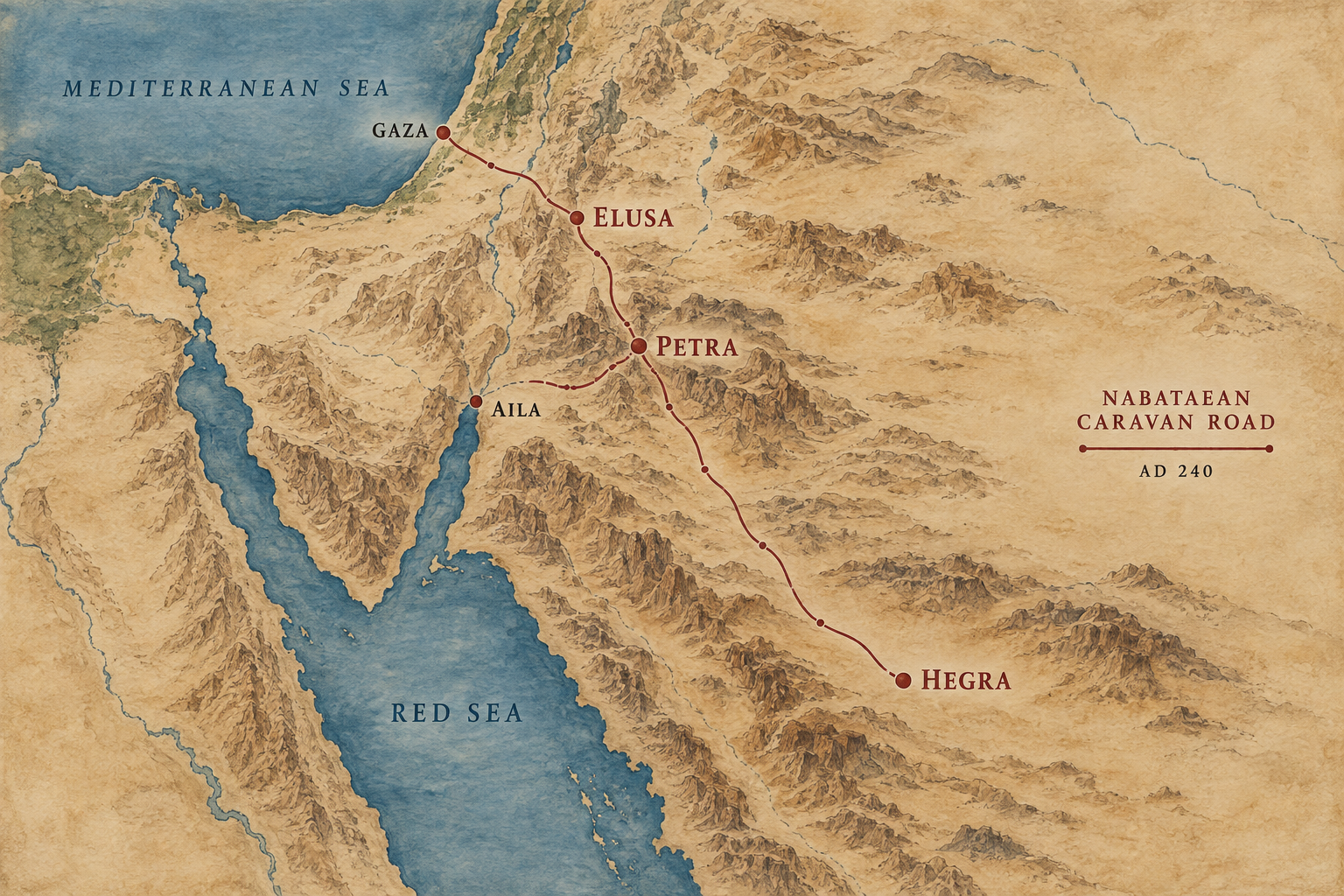
What did a caravan trader risk between Elusa, Petra and Hegra in AD 240—and why might he decide never to make the journey again?
“I’ve buried two camel‑masters in the sand.” Taimu says it flatly, the way a man states his trade, and Shelam lets the sentence stand.
Where are Taimu and Shelam?
Although he says he has come “from Petra,” the house is in Elusa, at the northern edge of the Negev, three days short of Gaza and the sea. The Nabataeans founded it around the third century BC as the last caravan station before the coast, and one of the earliest known Nabataean inscriptions, dating to around the mid-second century BC, was found there. Taimu’s family are the original stock of a place that exists because of the road he has just sold.
The road ran from Elusa southeast to Petra, then south through Hegra, following part of the old incense-route network towards the frankincense country. So “from Petra” means only the last, easier leg home. The hard part was already behind him when he reached the gate.
What did the road demand?
Distance. Hegra, today Mada’in Salih in Saudi Arabia, lies some 500 kilometres south of Petra in a straight line and much more by camel. Pliny counted the whole incense road in sixty‑five day‑stages; Petra to Hegra took perhaps three to four weeks each way, plus about a week each way between Elusa and Petra. Add the trading and the waiting, and you have Shelam’s arithmetic exactly: “gone half of every year.”
Water. A stage was the distance between one well and the next. A laden camel carries water for its men for a few days, not for itself and not for three weeks; if a cistern had silted or been drained by the caravan a week ahead, the next was two days on, and you counted as you walked. Taimu’s “I don’t like the water” is a trader’s shorthand for discomfort, not fastidiousness. Hegra’s wells were sunk deep into oasis alluvium, and oasis water is often brackish. Even the safe place was uncomfortable.
Season. Nobody crossed the Hijaz in summer who could avoid it. Caravans went down in autumn and came back before the heat — which is why Hanina “will go south in the autumn,” and why the half of the year Taimu spent at home was the hot half, the useless half. The three‑day wind that pins the household indoors is ordinary spring weather in the Negev; on the road it kills camels by sanding their eyes and men by erasing the landmarks. Shelam hears the wind as an inconvenience. Taimu hears it as something he has outlived.
People. Rome annexed Nabataea in 106, and historians long assumed the province stopped far north of Hegra. Then a Latin inscription found in 2003 showed that in 175–177 a detachment of the Third Legion Cyrenaica helped rebuild Hegra’s walls; in 2015 the Roman camp itself was located. Hegra was one of Rome’s farthest southern outposts. The rebuilt walls tell us that security at the empire’s southern edge mattered; beyond them, Roman authority became less dependable. At Ruwafa, north of Hegra, a Thamud group built a sanctuary in the 160s honouring Marcus Aurelius and Lucius Verus, with the involvement of Roman officials. Its inscriptions show local groups and imperial authority accommodating one another on the frontier. By the third century, Roman writers increasingly use Saraceni for mobile peoples on the desert fringe — usually from an outsider’s, and often hostile, perspective. For a caravan, the practical question was simpler: who controlled the next stretch of road? Taimu leaves robbers unmentioned. The question would have arisen, but nothing could be done about it, and he does not talk about what cannot be helped.
Illness. A caravan could not count on a physician travelling with it, and it could not stop for long. A fall, a scorpion sting or a fever caught at a well fouled by earlier caravans could become fatal. Two deaths in twenty years would not have required extraordinary bad luck. Shelam’s first guess, that he has “brought a sickness up the road,” therefore requires no melodrama. Illness belonged to travel as surely as thirst and delay did.
Why leave it in AD 240?
Because the road was dying, and Taimu could see it. The overland incense trade through the Hijaz flourished from the third century BC to the second century AD. By 240 Red Sea shipping carried Arabian and Indian goods straight to Egypt or to Aila at the head of the gulf; Palmyra’s caravans took the eastern trade; Hegra’s role was narrowing towards that of a garrison town. An inscription of 356 shows it still inhabited, under a local headman, and much shrunk.
The wider empire was not helping. Gordian III, still a teenager in 240, had come to power amid the Year of the Six Emperors only two years earlier. Roman silver currency had already undergone repeated debasement, and under Gordian the antoninianus was becoming the empire’s principal silver coin. To a merchant, the unsettling fact was simpler than the numismatics: the silver value behind the money was no longer something his grandfather could have taken for granted. Nobody in Elusa would have called this the third-century crisis. Taimu would have encountered it as fewer caravans, uncertain markets and unreliable money.
Selling his share to Hanina, a younger man, is a market decision: Taimu gets out while his standing with the Hegra men still has a price. His wish to be home is the part he cannot say straight, so he says it sideways, about the water.
Why the terraces?
The Negev gets 50 to 150 millimetres of rain a year. Ordinary rain-fed farming there is precarious. What grows is what the winter floods can be made to feed: stone walls built across the wadis to slow the runoff and hold the soil, with vines and barley in the beds behind them. In late antiquity that method made Elusa the largest city in the region, with a theatre, a bishop, and a wine — vinum Gazetum, shipped from Gaza — praised in Constantinople and Gaul.
But in 240 none of that had happened yet. The rubbish mounds say so: in Roman‑period levels at nearby Shivta, archaeologists found a single grape pip; by the fourth to fifth century at Elusa grape pips are 14 per cent of the grain‑and‑grape total; by the sixth, up to 43 per cent. A wetter phase began around the third century and lasted until the sixth, and the Negev farmers rode it.
From nearly eighteen centuries away, then, “I’ll take the terraces” looks like remarkably good timing: a man moving his capital from camels to land at the start of a boom. But Taimu cannot know what Elusa will become, and I have no evidence that anyone around Elusa in 240 was measuring runoff. I let him notice only what a merchant might plausibly notice: the road thinning, and the wadis behind his house running more often than he remembers from childhood. That is where the evidence ends and the novelist begins.
Shelam’s dye works belongs to the same geography. Madder grows wild in those wadis; indigo came up the road from the south; her cloth going “to Hegra under the family’s mark” is the route working in reverse, Negev goods going down as incense came up. Even the stink Taimu’s brother complains of — the stale urine kept for the vat — is the standard ancient mordant and the standard ancient complaint. The household was already half in the new economy before Taimu decided to join it.
Yonatan belongs to that borderland too. Elusa was Nabataean by foundation and Roman by administration, within reach of Judaea and Gaza, with Aramaic spoken locally and Greek in public inscriptions. I invented his presence in the household within that historical cultural mixture.
What I had to invent
Almost everything about the deal. Palmyra left inscriptions naming caravan leaders, partners and years; the Elusa–Hegra road left none. How a share was sold, what a camel‑master earned, how many animals a middling house kept, how a family split its money between road and land — all inferred from analogy. Elusa itself lies under sand and was quarried for Ottoman Gaza; the German–Israeli team there since 2014 has mapped most of it by geophysics, and the theatre and churches they have dug are later than this scene. The house — courtyard, women’s side, roof by an outer stair, back yard by the midden — follows the standard Near Eastern plan rather than a specific ruin.
The deal and the household are invented. The wells, Roman garrison, changing coinage, declining caravan trade and runoff landscapes of the Negev are historical; the characters are my attempt to imagine a life among them.
Read the story
Return to Third Day of the Wind, the fiction this essay accompanies.
Discover more from Angels with Black Wings
Subscribe to get the latest posts sent to your email.