
I
In the spring of the first year of Xianheng, 670, Bozhou had no rain.
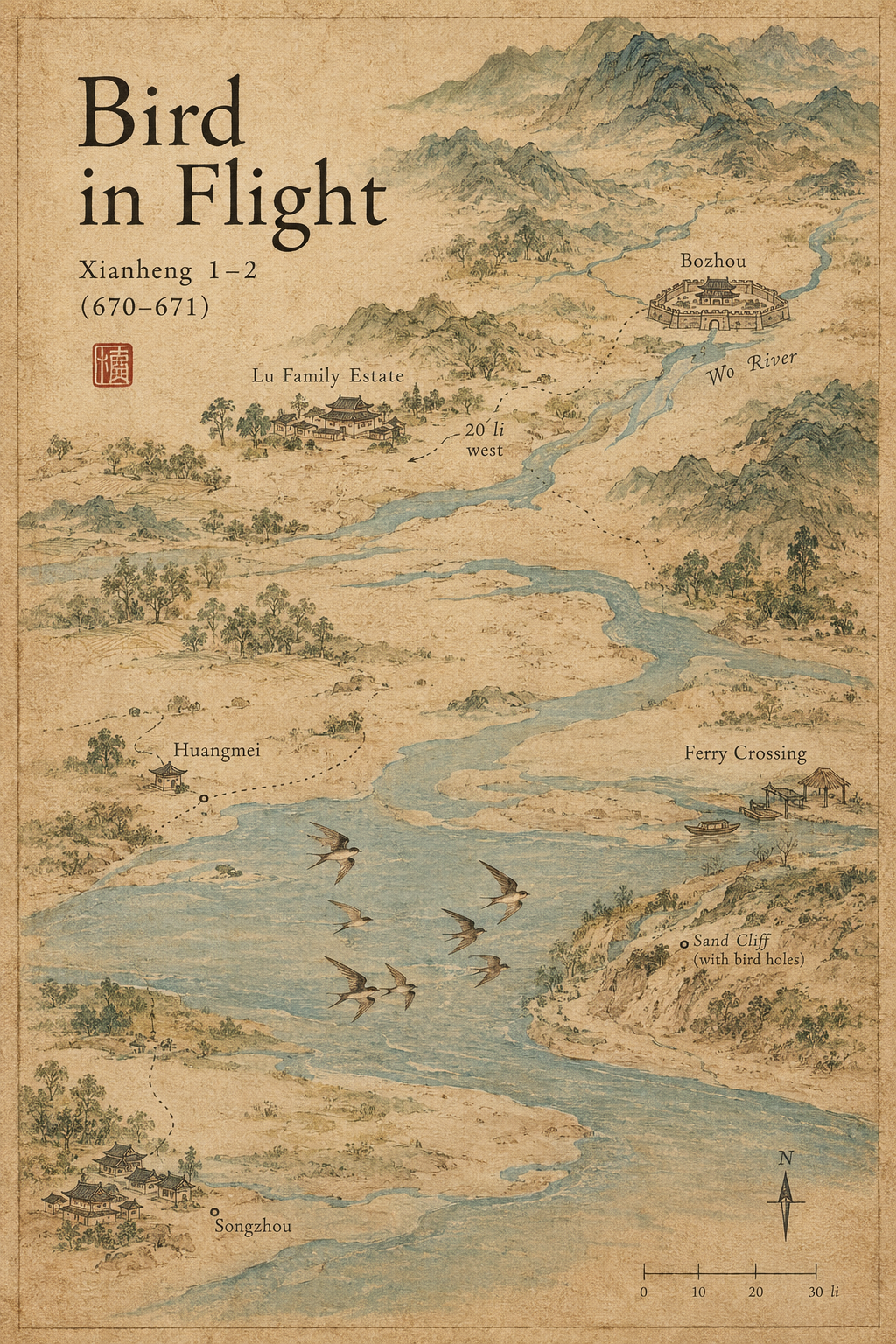
The Wo River had shrunk to half its breadth, exposing stretches of pale sand. The Lu family estate lay twenty li west of the city. The mulberries had put out their first leaves; the jujube trees were taking their time.
Master Lu had passed the examination in the Classics when he was young and spent several years as a minor official in Xuzhou before illness brought him home. He returned with a wooden chest containing some twenty hand-copied scrolls. In the countryside, this counted as a library.
His eldest son, Lu Shen, was twenty-seven and had already been head of the household on the register for six years. His father had handed the business over to him with the explanation, “I read Zhuangzi. I don’t read account books.”
So the fields, the taxes, the tenant registers, the marriages and funerals of the clan all came to Lu Shen. He never complained. He was the kind of man who always knew how many measures of millet were left in the granary.
His wife was a Xiao by birth. Her name was A-Xuan. She was twenty-four, the daughter of a minor official in Songzhou. Her father had no son, so he taught her the Analects, and later the Laozi. Halfway through that he became confused himself and left her to read on her own.
Dinner in the Lu household often went like this. Each had a low table of their own. The old man ate slowly. Halfway through the meal he put down his chopsticks.
“You are not a fish. How do you know the happiness of fish? I have always thought Huizi had a point. A-Xuan?”
“Huizi’s question was fair. Zhuangzi only won because he got the last word.”
“Outrageous,” Lu Shen said through a mouthful of steamed bread.
“Your grandfather used to say exactly the same thing.” The old man looked pleased.
They laughed.
In the courtyard, the old servant was feeding the chickens. They were eating last year’s millet.
A-Xuan loved this household. That must be said first.
II
In the third month, on the anniversary of her mother’s death, she took the maid A-Xing to offer a vegetarian meal at the temple east of the city. On the way back, they waited for a ferry at the Wo River crossing. Rain suddenly came down, brief and sharp—not enough to save the wheat, only enough to drive people to shelter.
Under the thatched shelter by the crossing sat a monk. His patched robe was washed pale, yet not clean. The strap of one straw sandal had snapped, bound with hemp cord. He was eating a sesame flatbread; seeds fell onto his knees, and he picked them up one by one and ate them.
A-Xing tugged at her sleeve. She walked over and stopped three paces away.
“Where have you come from, Master?”
He did not look up. He went on eating.
Rain drummed on the shelter roof. She asked again.
Still he ate. When the bread was finished, he wiped his fingers on his robe and looked out at the river.
She asked a third time.
“Huangmei.”
“What is at Huangmei?”
“An old monk.”
“What does he teach?”
“Sitting.”
“Must one leave home to understand?”
“Some say so.”
“What do you say?”
He watched the rain.
“I left.”
She took that for an answer. The boat arrived. She handed him the remaining steamed cakes from her basket. He took them. He neither thanked her nor seemed ungrateful.
III
She did not hide it. That evening she told Lu Shen.
He put down the register and looked at her for a long time. “You walked up to him—to a monk from who-knows-where, without knowing if he even carries travel papers—to ask about life and death?”
“Someone has to ask.”
“You could have asked me to go.”
“Would you have gone?”
He gave no answer. On the other side of the lamp, the old man coughed into his sleeve. She looked over. He was trimming the wick with his head down, the corners of his mouth turned in a smile. She did not know what he was smiling at.
Then, on the Buddhist fast days, she stopped eating meat. The kitchen noticed first, and then Lu Shen. He said nothing, only told the cooks to set aside a dish of mallow greens on those days.
She borrowed the Zhuangzi from the wooden chest. Handing it to her, the old man said, “A book needs someone to live it out.” With that he went back to his room. She thought: He has read it his whole life, and all he does is smile.
One night Lu Shen came in. She was reading beneath the lamp.
“What are you reading?”
“Zhuangzi.”
“Read it to me.”
She read aloud. When she reached “The Way is in the dung and urine,” he had fallen asleep. She was angry for a long time. The next evening he came in again, sat down, and said, “Where did we leave off yesterday?”
In summer, the drought worsened. The prefecture pressed for its tax silk. She sat weaving at the loom; the clatter sounded from dawn until noon. Lu Shen had even more to do: a clan uncle wanted to mortgage his land and needed him to intervene; a cousin had been conscripted into the army, and his gear had to be outfitted by the household; a bolt of silk fell short in measure, and the tax bailiffs came twice.
One night he sat for a long time and said, “If I weren’t head of the household, I’d come with you to ask.”
She did not reply. She heard if I weren’t. She missed I’d come with you.
In the morning he asked, “Did you sleep?”
“I slept.”
She had not slept. She watched him cross the courtyard and go out the gate.
She thought: He is a good man. But he cannot keep up.
She spoke of it no more. She did what needed doing as before, her face the same face as always.
IV
In autumn, news of the defeat at Dafeichuan reached Bozhou. The price of millet doubled. The cousin departed. Lu Shen saw him off at the city gate, came home, and sat for a long time without speaking. She wanted to say something to him, thought better of it, and kept silent.
Her thoughts turned to the nunnery south of the city. It was no idle daydream; she knew what would be required, and had even chosen the nunnery.
Winter passed. The old man fell ill once, but not severely. Lu Shen grew thinner. The sound of the loom stopped, and started again.
V
In the early spring of the second year of Xianheng, she went to the ferry crossing again.
He was there too, with a cloth sack and another pair of old straw sandals. He said he was heading south.
The river was still thin. On the sandbar, a flock of small brown birds skimmed low over the water, their wings trembling. They were smaller than house swallows, greyer than house swallows, and never flew beneath the roof eaves. She had never noticed them before.
“Where do those birds live?”
He watched them for a while.
“They fly south in autumn and north in spring. They cross from one land to another, but make a home in neither.”
She understood at once. That was her.
The poem from last autumn suddenly had its final line. Standing there, she felt an unexpected joy.
The boatman’s young daughter was squatting nearby washing mallow leaves. She looked up and said, “Sand swallows. They live in the riverbank.” With a wet hand she pointed upstream. “Past the bend, the sand cliff is full of holes, packed close together. They come every year.”
A-Xuan looked where the girl pointed. Past the bend upstream there was only a high sandy bank; no holes could be seen. She had never walked that way.
“If you didn’t know, why did you lie?”
“You asked where it lives.”
“And so?”
“I didn’t know.”
“Then why answer?”
He shifted the sack to his other shoulder.
“You liked the answer.”
She turned on her heel and walked away. A-Xing followed at a trot. After half a li, her feet began to ache, and she grew hungry. Looking back, he was sitting under the shelter, eating bread. The world refused to make a metaphor for her.
The boats at the crossing went on as before: upstream, downstream, across. Their oars made no single rhythm.
VI
At dinner, he waited for her. On the low table stood an extra plate of jujube-paste steamed cakes. He nudged the plate toward her.
She ate one.
“That monk,” he said. “What did he teach you?”
“He lied to me.”
He looked up, his expression changing.
She smiled. “It was useful.”
He stared at her. “What do you mean?”
Usually she would have said, “Nothing.”
“I’ll read to you tonight,” she said. “A little slower. If you fall asleep, I’ll stop, and pick it up tomorrow.”
He looked at her as if he did not quite believe this. After a moment, he nodded.
On the other side of the room, the old man coughed into his sleeve. This time she did not try to guess what it meant.
The holes in the riverbank—she had not yet gone to see them.
Discover more from Angels with Black Wings
Subscribe to get the latest posts sent to your email.